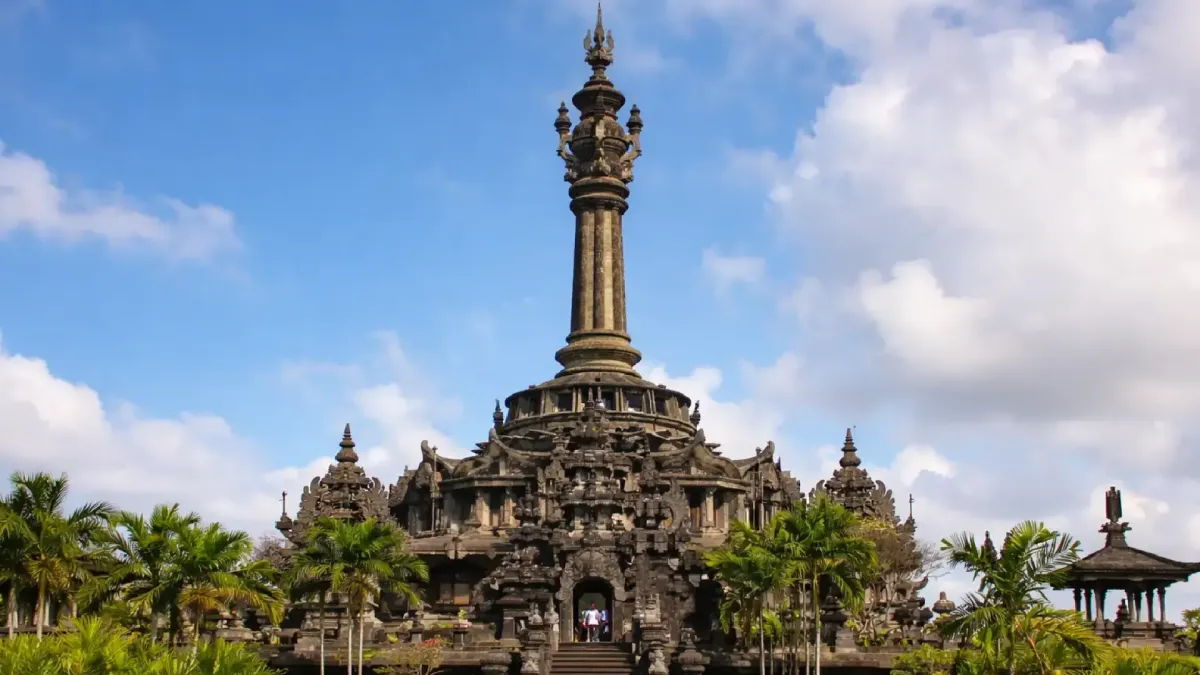
Towering above the sprawling green lawns of Lapangan Niti Mandala in Renon, Denpasar, the Bajra Sandhi Monument (officially Monumen Perjuangan Rakyat Bali) is one of the most recognizable and culturally poignant architectural landmarks in the provincial capital. While international tourists frequently bypass Denpasar in favor of beach clubs in Canggu or wellness retreats in Ubud, travelers who make the journey to Renon discover an imposing basalt stone sanctuary that encapsulates millennia of Balinese resilience—from ancient prehistoric times to the Dutch colonial wars and modern independence.
Designed in the shape of a colossal Bajra (the sacred bronze prayer bell rung by Balinese Hindu high priests, or Pedanda, during liturgical ceremonies), this monument is far more than a decorative civic plaza. Inside its cool stone walls lies an extraordinary three-story historical museum featuring 33 three-dimensional dioramas, ancient weapons, royal genealogies, and an ethereal top-floor meditation room (*Ruang Ketenangan*) offering 360-degree panoramic views across Denpasar toward the distant silhouette of Mount Agung.
1. Architectural Symbolism: The Cosmic Bell and Independence Dates
Conceived in 1981 by the renowned Balinese architect Ir. Ida Bagus Tugur and officially inaugurated by Indonesian President Megawati Sukarnoputri in June 2003, the architecture of Bajra Sandhi integrates classical Hindu cosmological philosophy with modern national history:
| Architectural Element | Numerical Value | Historical & Cosmic Significance |
|---|---|---|
| Main Entrance Gates | 17 Steps | Represents August 17, Indonesian Independence Day. |
| Central Grand Pillars | 8 Colossal Columns | Represents the 8th month (August) and the eight cardinal directions (*Asthadikpalaka*). |
| Total Monument Height | 45 Meters | Commemorates the year 1945, the birth of the Republic of Indonesia. |
| Roof Structure | Bajra (Sacred Bell) | Symbolizes spiritual purity, divine resonance, and cosmic order under Tri Hita Karana. |
The monument's layout adheres to the classical Balinese architectural code of Tri Mandala, divided into three spatial zones: the outer ceremonial gardens (*Nista Mandala*), the middle courtyard (*Madya Mandala*), and the inner stone sanctum (*Utama Mandala*).
2. Exploring the 33 Dioramas: A Chronicle of Balinese Heroism
The second floor of the monument houses the museum's core exhibition: a circular gallery of 33 detailed, hand-carved dioramas encased in glass viewing vitrines. Arranged chronologically in a clockwise circuit, these dioramas narrate the comprehensive history of the Balinese archipelago:
- The Prehistoric & Megalithic Era (500 BCE): Depicts early stone sarcophagus burials and agrarian settlements in Gilimanuk and Kembangsari.
- The Warmadewa Dynasty (8th–10th Century CE): The reign of King Sri Kesari Warmadewa, celebrated in the Belanjong Pillar inscription in Sanur, establishing the earliest written records of Balinese civilization.
- The Golden Age of Majapahit & Gelgel: The arrival of Mpu Kuturan, Dalem Waturenggong, and Dang Hyang Nirartha, establishing Bali’s unique synthesis of Shaivite Hinduism and indigenous ancestor veneration.
- The Anti-Colonial Resistance & Puputan Wars: Visceral, emotional depictions of the Puputan Badung (1906) and Puputan Klungkung (1908), where royal courts sacrificed their lives against colonial cannons to preserve their sovereign honor.
- The Battle of Margarana (1946): The heroic resistance led by National Hero I Gusti Ngurah Rai and the Ciung Wanara battalion against Dutch post-WWII reoccupation, fighting to the last breath in the jungles of Tabanan.
3. The Apex Viewing Gallery (Ruang Ketenangan)
At the center of the second floor, a magnificent spiraling stone staircase (*Tangga Melingkar*) ascends through the core of the monument into the 45-meter-high apex room, known as Ruang Ketenangan ("The Room of Serenity").
Enclosed by tall glass windows looking out in all four cardinal directions, this quiet sanctuary is designed for quiet contemplation. The ambient noise of the city below fades away, replaced by the gentle rustle of coastal breezes. On clear mornings, you can gaze north toward Mount Batur and Mount Agung, and south toward Benoa Harbor and the limestone cliffs of Bukit Peninsula.
4. Practical Visitor Information: Tickets, Hours & Dress Code
- Location: Jl. Raya Puputan No. 142, Panjer, Kec. Denpasar Selatan, Kota Denpasar, Bali 80234.
- Opening Hours:
- Monday to Friday: 08:00 AM – 06:00 PM WITA.
- Saturday & Sunday: 09:00 AM – 06:00 PM WITA.
- Entrance Fees (Official 2026 Rates):
- International Adult: IDR 50,000 (~USD 3.20)
- International Child: IDR 25,000 (~USD 1.60)
- Domestic Adult: IDR 25,000
- Parking: IDR 2,000 (Scooter) / IDR 5,000 (Car)
- Dress Code & Etiquette: While Bajra Sandhi is a civic monument and museum rather than an active consecrated temple, respectful casual attire is required (shirts covering shoulders and shorts or skirts of modest length). Shoes must be removed before ascending to the top meditation chamber.
5. How to Combine Bajra Sandhi with a Denpasar Day Trip
Pair your visit with authentic local experiences within 10 minutes of Renon:
- Morning Walk at Lapangan Niti Mandala: Arrive at 07:00 AM to see hundreds of local Balinese jogging, practicing Tai Chi, and enjoying the shade of towering banyan trees.
- Culinary Heritage Lunch: Visit Warung Mak Beng in Sanur for legendary fried fish and spicy fish soup (*sup ikan laut*), or try authentic *Ayam Betutu Khas Gilimanuk* near Renon.
- Cultural History Continuation: Head north to Taman Budaya Art Center Denpasar to admire classical Balinese woodcarvings and open-air amphitheatres.
Bajra Sandhi is an essential cultural pilgrimage for any traveler who wishes to truly understand the spiritual grit and sacrificial heroism that forged modern Bali.